Tuesday, September 13, 2011

Queen of Wands

She inspires people to find hope and faith through action. With a wand in one hand ready for action, and a sunflower in the other, symbolic of the sun as a ray of hope. The queen who sits upon this throne conjures thoughts of Joan of Arc.

The people of France were feeling defeated after years of losses in battle. Their moral was at an all-time low when Joan of Arc claimed that the voice of God was instructing her to take charge of her country’s army and lead it to victory.

Joan of Arc believed that she was divinely guided to lead her people out of despair and into victory in the ongoing war. She claimed that the voices of angels and saints told her to deliver her country from the invading English. She was also told that she must lead Charles VII to his coronation.

After gaining the approval and authority to do so, she led her army and broke the siege of Orleans in only three days of fighting. She became known as the beloved maid of Orleans.

Joan of Arc crowned Charles VII King of France on July 17, 1429. In the great Cathedral of Reims, Joan fulfilled the central part of her mission when he was crowned King.
The Queen of Wands card also depicts a black cat sitting at the feet of her throne. Considering that the black cat is often seen as a sign of witchcraft, the symbolism in this card further reminds us that Joan of Arc’s fate would be sealed as an accused heretic. She was captured by Burgundian soldiers and sold to the English for ten thousand gold francs.  Joan of Arc was put on trial for heresy and burned to death on May 30, 1431.

A sad ending to a heroine who delivered her people from the depths of despair towards victory. However, she fulfilled her prophesy, and restored the dignity and faith of her people.

Perhaps we should seek inspiration too so that we can reclaim our own hope and faith in order to take action in our lives. A little bit of inspiration can go a long way towards finding our purpose again so that we can pursue our dreams and ambitions. Remembering that the policy of paying if forward as we try to inspire others with our actions has a rippling effect that could have far-reaching positive results for those who are touched by our contributions, no matter how humble they may be.

Today, as the Queen of Wands inspires us from her sunlit throne, I’d like to close in sharing the wonderfully inspiring poem ‘Desiderata’ by Max Ehrmann;

“Go placidly amid the noise and haste, and remember what peace there may be in silence.
As far as possible, without surrender, be on good terms with all persons. Speak your truth quietly and clearly; and listen to others, even to the dull and the ignorant, they too have their story. Avoid loud and aggressive persons, they are vexations to the spirit.
If you compare yourself with others, you may become vain and bitter; for always there will be greater and lesser persons than yourself. Enjoy your achievements as well as your plans. Keep interested in your own career, however humble; it is a real possession in the changing fortunes of time.
Exercise caution in your business affairs, for the world is full of trickery. But let this not blind you to what virtue there is; many persons strive for high ideals, and everywhere life is full of heroism. Be yourself. Especially, do not feign affection. Neither be cynical about love, for in the face of all aridity and disenchantment it is perennial as the grass.
Take kindly to the counsel of the years, gracefully surrendering the things of youth. Nurture strength of spirit to shield you in sudden misfortune. But do not distress yourself with imaginings. Many fears are born of fatigue and loneliness.
Beyond a wholesome discipline, be gentle with yourself. You are a child of the universe, no less than the trees and the stars; you have a right to be here. And whether or not it is clear to you, no doubt the universe is unfolding as it should.
Therefore be at peace with God, whatever you conceive Him to be, and whatever your labors and aspirations, in the noisy confusion of life, keep peace in your soul.
With all its sham, drudgery and broken dreams, it is still a beautiful world.
Be cheerful. Strive to be happy.”

Sunday, September 4, 2011

Queen of Swords


A proud queen sits upon her throne. Her body is turned away from the reader, instead she appears to be looking far into the distance, the expression on her face is stern. In her right hand she holds a sword upright, ready for battle. Known to be one who does not suffer fools gladly, she is incisive in her choice of words and her decisions. Storm clouds are building on the horizon, and trouble is blowing in on the strong winds.

While contemplating this card I was reminded of another queen, one known as Boadicea, queen of the Iceni who led her people to a glorious war against the Romans between AD 61 and AD 63.

In the words of Olivia Jensen, “the Iceni Celts had submitted their kingdom in East Anglia to the conquering Romans and the rule of Emperor Claudius in AD 43. In AD 61, Prasutagus, Boadicea's husband and King of the Iceni died. A dispute followed during which Boadicea, was publicly beaten by the soldiers of the emperor, and her two daughters raped.”

 Boadicea was so enraged at this violation that she rallied all the other neighbouring tribes and persuaded them to rise up with the Iceni against the mighty Rome. She started a revolution that took the Romans by surprise, because while the Iceni was too small a tribe to challenge Rome alone, in their common cause the neighbouring tribes with the Iceni were large and fierce enough to create a lot of trouble for Rome.

Boadicea and her people burnt down many Roman towns to the ground including London. She was one pissed-off queen! Fuelled by her anger and her desire for revenge she took on the might of Rome. Being tribal warriors Boadicea’s troops had no particular battle strategy, instead they fiercely rushed in where others would not dare to go, taking the Roman troops by surprise, time and again. This non-strategy approach worked well at first. The Roman troops were repeatedly taken by surprise, defeated and humiliated until they eventually brought in battle-hardened soldier troops to defeat her.

Back to the Queen of Swords card we see a butterfly adorning her throne.  We also notice that she wears a bell, dangling from her left wrist. The butterfly has come to symbolize a metamorphosis in many cultures, it heralds in something new and also symbolizes time along with many other things. The bell is used by the church to call people in, it is also used in occult circles to ward off unwanted influences. And it signals that the time has arrived for church service or occult ritual to begin.

There comes a time in most of our lives when we are prompted to stand up against injustices and violations of our rights or the rights of those who are weak and helpless. There is nothing wrong with standing up for our rights, it is a necessary action to ensure that the world we live in is just and the governments that rule are held accountable. However, like the Queens in tarot we need to exercise wisdom by choosing our battles carefully and to know when to leave well alone. Being a card of Swords we know that this queen is able to articulate herself eloquently and to use the power of the word to persuade others to follow her example, instead of allowing anger to drive her. Perhaps a lesson that we can draw from this card is to ensure that we have a strategy before going into battle. We may want to choose our words carefully and with firm determination execute a stern but strategic challenge against the bullies of our society to ensure that we are heard and not defeated in the process. We may be wise to seek opportunities to communicate our concerns, and while we should not shy away from a challenge that can benefit from our input, giving into uncontrolled anger will only serve to hurt us and others in the process.

It might be wiser to remember that the pen (or in this case the tongue) is far mightier than the sword.

Sunday, August 28, 2011

Two of Wands


This card depicts the image of a man standing between two wands or staves examining the world globe in his right hand as he looks out over a vast body of water.

These pillars between which he is standing is reminiscent of the pillars of Hercules that flank the entrance to the Strait of Gibraltar, upon which was inscribed the warning “Non plus ultra” meaning nothing further beyond. This served as a waring to sailors and navigators to go no further.

In medieval times most people lived on the Mediterranean, with Morocco to their left and Spain to their right, thereafter nothing but the vast Atlantic Ocean. The Atlantic Ocean was largely unexplored, it was the great unknown. There were no maps to navigate an explorer, thus a voyager would be entering the unknown with nothing but the stars to guide him. The man in this card could very well be standing at the Straits of Gibraltar, with the Mediterranean behind him, about to venture into an exploration of the unknown.

Shifting paradigms. There comes a time when each of us must stand between the pillars of Hercules where we embark on new idea, new sciences, new thought; and find the courage of our conviction to step through and into new paradigms of discovery.

One such man was Christopher Columbus who – being Italian – approached the Italian aristocracy for financial support on his envisioned exploration of discovery.  They scorned him and withheld  their support. After all the church did not encourage its people to embark on such explorations. The fear of new knowledge and influences brought into a society under the firm control of the church was far too great. The world, they said, was flat, and the fate of anyone who dared to explore the great unknown Atlantic Ocean was to drop off the end of the earth.

Not deterred and more determined than ever, Columbus turned to the Spanish Royal family for support. They were more adventurous and generous, financing his fleets the supplies needed onboard and the wages for his crews. Columbus ventured forward, exploring new paradigms against great adversity and fear of the unknown, ultimately resulting in the discovery of North America.

The suit of Wands represents action. It informs us that now is the time to act on our convictions. Time to step through these Pillars of Hercules that represent new paradigms of ideas. It is time to explore those ideas, allowing them to take us on a journey of discovery. Who knows what we may discover about ourselves and our world if we dare to question what we think we already know.

Are we ready to depart our comfort zones, our metaphorical Mediterranean, to explore the unknown? Can we allow ourselves to consider and examine new ideas and possibilities? Where will they take us? What great oceans do we need to conquer, what great unknowns will we need to face? We may approach this as Rita Dove did when she said “I prefer to explore the most intimate moments, the smaller, crystallized details that we all hinge our lives on.”

Perhaps we aren’t as adventurous as Columbus was, our discoveries less grand, but each of us are regularly faced with new thoughts and ideas that do not comfortably sit within our own frame of reference. Ideas that we might otherwise dismiss as they would require us to move out of our comfort zones in order to explore them. Today we are invited to examine those unknowns and to shift our own paradigms in doing so. What better way to do this than to follow the example of Rudyard Kipling by beginning with questioning everything. He said:

“I kept six honest serving men
They taught me all I knew
Their names are What and Why and When,
And How and Where and Who.”

Sunday, August 21, 2011

Three of Cups


This is a truly beautiful card, one that depicts 3 women dancing in a circle in a celebratory manner, each raising a toast to the sky.

The sky is bright and blue, no sign of clouds or rain. At their feet lie the fruit of their labour, an abundance of harvest.

In Norse mythology we find reference to the three creatures of time, they who determine fate. Called the Norns, they were known as Urd, Skuld and Verdandi, respectively the past, present and future. Before they came to Asgard time did not exist, therefore they were considered above even the gods, as fate could not be determined without time. The Norns would visit each being, humans as well as  gods immediately after they were born to determine their future.  Just like the Fates in Greek mythology, these three creatures determined how long every individual would live.  The Greek Fates were called Clotho (the spinner,) Lachesis (the drawer of Fates,) and Atropos (the inevitable.) Clotho would spin out the newborn’s thread of life, Lachesis measured it and decided what was going to happen to this being, and Atropos cut the thread. They were often depicted around a spinning wheel or a cauldron.

The past, the present and the future. Whom amongst us has not at times wished that we could go back into the past to change something, or that we could travel to the future to gain knowledge as yet unknown to us. It is usually as we mature that we realize we have no business in either the past or future, as all we have and are is in the present. The power of Now.

Why is it that Guru’s and psychologists say the same thing, namely the importance of living in the present? Could it be that they know something we are still learning? Living in the ‘now’ is called mindfulness. It is at the root of Buddhism, Taoism and yoga. Mindful people are happier people, they are more exuberant, more secure and more empathetic. The health benefits of living in a state of mindfulness includes reduced stress and blood pressure, it boosts the immune system and reduces chronic pain.

Everyone agrees that it is important to live in the moment, but how do we do this because when we are not in the moment we are not there to know we are not there… Overriding the distraction reflex and awakening to the present takes practice and intention. Living in the moment contains a profound paradox, we cannot live in the moment in anticipation of future benefits, because that launches us out of the moment and into the future, which subverts the entire process. It requires us to trust that the rewards will come.

As we live in the moment, the past and future slot into their rightful places and our perspective changes quite dramatically. No longer are we regretful or guilty for past mistakes, we acknowledge the value of these as they brought us to where we are now. We become more accepting of our own imperfections. James Thurber said: “Let us not look back in anger, not forward in fear, but around in awareness.”

Living in the moment has the added benefit therefore of helping us place a healthier perspective on the events of our lives, and in a sense helps us to ‘tie-up’ many loose ends that we may otherwise leave dangling to trip over.

The celebration that we see in the 3 of Cups could very well be ours as we bring into alignment our own past, present and futures. Trust is very much a ‘feeling’ thing, therefore the suit of Cups from which this card comes perfectly reflects to us that we are required to feel our way into mindfulness rather than through analysis and expectation. Our thoughts may come and go, thoughts of the past and future. A simple acknowledgement is all that is required as we maintain the state of mindfulness without allowing the distractions to derail our process.

In closing let’s contemplate the words of Jeb Dickerson who said: “I need neither future nor past, but to learn to take today not too fast.”

Sunday, August 14, 2011

Knight of Cups


We see a gallant knight proudly mounted on his steed. He has a cup in his outstretched hand as an offering. His helmet and footwear are adorned with wings, much like Apollo who was known as the messenger of the gods.

When contemplating this card, the legend of Sir Galahad came to mind. The brave and pious knight of king Arthur’s round table at Camelot. He was the son of Sir Lancelot, and the chosen one whom Merlin had prophesied would surpass his father in valour and be successful in his search for the Holy Grail.

This was a dangerous mission, many knights before him had died in pursuit of the Grail. He had been warned of the dangers, but chose to continue on his quest. He defeated rival knights with little effort, kept to himself, didn’t speak much to his companions, and was described as sinless and pious.  It is believed that because of these virtues he was able to lead his companions to the Holy Grail with relentless determination.

Of the three knights who undertook the quest for the Holy Grail, with Sir Bors and Sir Perceval, Galahad was the one who actually achieved it. When he did he was consumed by a bright light and died, taken up into heaven like the biblical patriarch Enoch or the prophet Elijah, leaving his companions behind in awe and wonder.

It is the spirit of youth that drove this knight on his quest for the Holy Grail, while brave and virtuous he lacked the wisdom of the Queen or the experience of the King in tarot terms. It is therefore that he ignored the warnings of danger before ultimately being consumed by the light to join his maker in death. He was told of the risks, but went ahead regardless.

Today’s message is all about taking the risks needed to accept opportunities and gifts presented to us. At times it becomes necessary to tap into the spirit of the Knight of Cups, and to accept the quest of the Holy Grail spurred on by the message of the gods as symbolized by the wings of Apollo.

The Holy Grail may present itself to us as an opportunity to learn something that will make us better people.  After all the Grail is exactly that, an object so holy that only the purest in spirit may stand in its presence. It is attainable only to those who have prepared themselves spiritually as the saintly Galahad did, and it is for this reason that we need the energy the drive and the determination of this knight in pursuit of our own Holy Grail. Our spiritual development prepares us to stand in the presence of this sacred discovery, namely that spark of divinity that is present within all of us.

Today this card also nudges us to accept the gifts offered to us by the messenger of the gods. Gifts that will come in different forms for each of us, depending on where we are in our spiritual development. The point is to recognize it as a gift, and to accept it in order to further develop our beautiful spirits. A gift can come in the form of a message that has the potential to impact us in a way that will allow change.

Yes, we may lack the wisdom or knowledge of how to fully utilise this gift when it is presented to us, but that too is part of the learning process. As we accept who we are, and allow our inner guidance to present us with messages, gifts and even opportunities designed to grow our spirit, so too shall we mature in wisdom and knowledge of application and effect.

When we accept a spiritual gift or message, we may want to remember that these gifts are not meant to build character, they are meant to reveal it.

Sunday, August 7, 2011

Three of Swords


The imagery on the Rider Waite Smith card shows a heart impaled by three swords. Sharp as they enter the heart, and blunt as they exit. The suit of Swords refers to the realm of thought, or the intellectual realm.

We have all experienced how our sharp reasoning abilities can become dulled and blunt when we allow our emotions to dictate our thoughts, particularly if we become obsessively emotional about something.

The 3 swords impaling the heart has been interpreted by many other tarotists to mean a love triangle. Today I’d like to play with that interpretation a little.
When considering the heart one can hardly do so without reference to Cupid, the cherubic archer of Valentine's Day. This myth of Cupid reads like a faerie tale:
Once upon a time there was a king with three daughters. They were all beautiful, but by far the most beautiful was the youngest, Psyche. She was so beautiful that people began to neglect the worship of Venus, the goddess of love and beauty. Venus became very jealous of this girl who was a mere mortal, and asked her son Cupid to make Psyche fall in love with a horrible monster. When he saw how beautiful she was however, Cupid dropped the arrow meant for Psyche and pricked himself with one of his own arrows instead, thus he fell in love with her.
After many trials and tribulations, and much heartache, much of which was metered out by the angry and vengeful Venus upon Psyche, the tale ends with Cupid and Psyche marrying and Psyche becoming a Goddess herself. Venus thus eventually accepts their union as the admiration of mortals is no longer drawn away from her by another mere mortal.
In this tale we see the destructive elements of this love-triangle when Venus can no longer reason without her emotions getting in the way. We see how jealousy and anger blunted the sharp reasoning abilities of the Goddess Venus, and how her desire for revenge on the beautiful Psyche results in the one she loves, her son Cupid, falling in love with her nemesis, Venus’ revenge resulting in heartache for him as much as for Psyche. We see how Venus’ love for Cupid and her loathing of his lover Psyche, are closely interwoven, reminding us that there is a fine line between love and hate.
There is an Arabic proverb that says: “Love sees sharply, hatred sees even more sharp, but jealousy sees the sharpest for it is love and hate at the same time.”
We are reminded that the heart is a universal symbol that renders us all equally vulnerable. No-one is immune to it. Even the cold-blooded and seemingly indestructible cannot escape this vulnerability. It is no co-incidence for example that the one way to slay a vampire is by driving a steak through its heart.  Everyone is vulnerable to love. Love however cannot be experienced without allowing our vulnerabilities to be exposed to one another. Therefore, nobody is immune to heartache and disappointment either.
We would do well to consider how our thought and reasoning processes can be dulled and blunted when we allow our emotions to overrule our common sense, or when we act out of vengeance from a place of hurt, as we often lack control of our thoughts that are no longer sharp in such situations.
Thus the moral of our story today is that we should carefully consider how our angry and sometimes jealous words wound not only our perceived enemy, but how we and those whom we love are drawn into and affected by the pain we often sharply measure out.  Few have said it better than Def Leppard who sang: “Can’t stop the hurt inside, when love and hate collide.”

Sunday, July 31, 2011

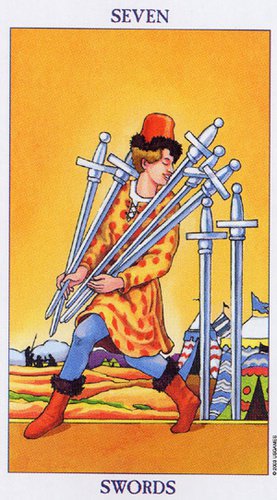
Seven of Swords


This card often conjures feelings of being robbed or cheated out of something. However , today I’d like to focus more on the intent of the character in the card who seems to be doing the cheating or robbing.

Loki, from the Norse tradition, is the god of thieves and mischief. In one myth he tricked Hod who was blind, into killing his beloved brother Balder, son of Odin, with a dart made of mistletoe – the only plant which had not sworn to never harm Balder. The imagery on this card is reminiscent of the wiles of Loki, and particularly prevalent on the face of the main character as he sneaks away in mischief.

In the seven of Swords card, we see a figure tip-toeing away; silently carrying away swords that clearly do not belong to him. It is apparent from further examination of this card that the scene is one of a jousting tournament. Tournament tents colourfully displaying their competing flags stand in the background. In the distant background a circle of knights stand together discussing the tournament in preparation of the competition. The scene is set for knights to display their skill and strength in this most important tournament. As was customary, the knights would bring their squires to such events. Medieval squires were the servants of the knights, in their training to become knights themselves. It was a very noble profession to be a knight, and a privilege to be a medieval squire, as that meant, more often than not, a potentially promising future if trained and knighted.

Back in the card, one can almost hear the squires of the various knights, hard at work in service of their masters to ensure that all the preparation are taken care of and that they have been thorough in their duties towards their knights.  The squires – like all squires of the time – are young and still need to prove themselves. They are in the service of their knights who will eventually train them to become  knights too. It would be self-defeating and self-destructive for these young squires to risk their entire future by being derelict in their duties towards their knights. Nothing could be more important to a young squire than  to ensure that all his master’s needs and expectations are taken care of, and that he has been diligent in his duties towards his benefactor.

Our attention is drawn back to the predominant figure in the card, that of the squire who is carrying away the very swords needed by the knights to perform their duty at the tournament. Judging by the expression on the face of the mischievous squire, he is not concerned at all with the consequences of his trickery! He has a self-satisfied grin on his face that tells us he finds the situation rather funny. A practical joker, that’s what this squire seems to be. Loki in all his mischievous glory. Which is all good and well, but how will the knights react when they discover that their swords have been misplaced, hidden or stolen from them? How will this impact on the tournament itself, that is kept waiting, while the tools of the trade are missing? Can you imagine the fury of the knights as they suffer humiliation at being disarmed? The fear of punishment and loss of future opportunities that potentially face the other young squires as their masters and knights look to them when it is discovered that their swords have been stolen, is almost tangible. Yet, it seems our irresponsible squire has not considered the impact of his practical joke on those around him, or himself. It seems that not a moment’s thought was given to the despair and confusion that this situation would cause for the knights, their squires and the tournament hosts. The severity of the situation is entirely lost on this squire.

This card reminds us that we should be mindful of how our actions may aversely affect others, even if our intent was not to harm. It cautions us to take responsibility for our actions, and to recognize when we have inadvertently hurt others simply because we weren’t paying attention, or because we didn’t consider the potential consequences of our actions.

When we do things that cause others pain, we cause ourselves pain.  When we do things that cause us to work against our own hopes and dreams we are self-sabotaging. Consideration of others happiness and welfare is paramount in our quest for self-development, but, as with so much else it all begins with the relationship we have with ourselves.