Showing posts with label Seven. Show all posts

Sunday, January 15, 2012

Seven of Wands


Today’s card speaks of standing our ground, even against overwhelming odds, to claim victory. When this card appears it tells us that we have made progress, and the worst is over.

Rarely in military history have the odds been so unequal and the stakes so high. One of the largest armadas ever assembled appeared off the Mediterranean island of Malta. Its 200 ships had been sent by Suleiman the Magnificent, sultan of the vast Ottoman empire to destroy the Knights of Malta who had long been a thorn in his side. Aboard were crammed some 40,000 fighting men, including 6,000 of Suleiman’s elite infantry.  Opposing this force were just 600 knights, a few thousand mercenaries and a few thousand Maltese irregulars – in all between 6,000 and 9,000 men. Once Malta fell the Turks would evict the Spanish from Tunis and then invade Sicily and Italy. However, in spite of the odds the Knights of Malta became the heroes of the age and the siege - one of the most celebrated events of the sixteenth century. Nearly 200 years later Voltaire could write, ‘Nothing is more well known than the siege of Malta’. These Knights of Malta gained glory and fame for standing their ground against overwhelming odds, which prevented the Turks from invading Italy. If the Knights of Malta had lost, as was expected, Malta would have been the springboard for the Turks to invade the rest of Europe.

Standing our ground against overwhelming odds.

More recently two ordinary people stood up against the fast-food giant McDonalds in a matter that became known as McLibel. Gardener Helen Steel and postman Dave Morris successfully humiliated McDonald’s in the biggest corporate PR disaster in history. McDonald’s loved using the UK libel laws to suppress criticism. Major media organizations like the BBC and The Guardian crumbled and apologized. But then they sued Helen Steel and Dave Morris. In the longest trial in English legal history, the “McLibel Two” represented themselves against McDonald’s £10 million legal team. Every aspect of the corporation’s business was cross-examined: from junk food and McJobs, to animal cruelty, environmental damage and advertising to children.

Outside the courtroom, Dave brought up his young son alone and Helen supported herself working nights in a bar. McDonald’s tried every trick in the book against them. Legal manoeuvres. A visit from Ronald McDonald. Top executives flying to London for secret settlement negotiations. Even spies. Seven years later, in February 2005, the marathon legal battle finally concluded at the European Court of Human Rights. And the result took everyone by surprise – especially the British Government. McLibel was not just about hamburgers. It was about the importance of freedom of speech now that multinational corporations are more powerful than countries. McLibel is the David and Goliath story of two people who refused to say sorry for criticizing McDonalds and creating public awareness about the misleading advertising claiming that the food is nutritious and offers a balanced diet. They refused to apologise, proving instead that McDonalds questionable marketing was aimed at children by using a clown mascot – Ronald McDonald – to manipulate and brainwash kids. Kids who’s choice of food as well as their eating patterns and habits would determine what they would eat for the rest of their lives. And in doing so,  Helen Steel and Dave Morris changed the world for the better.

These two ordinary people stood their ground, they held McDonalds accountable to society on behalf of society. They are hero’s of our time and perfectly demonstrate the deeper meaning behind what the Seven of Wands card is trying to tell us. Just because the odds are stacked up against us it does not necessarily mean that we are fighting a losing battle. At times it is good and even necessary to stand our ground, and who knows, perhaps we too will taste victory in doing so.

Source:

Monday, January 2, 2012

Seven of Cups


The first impression that this card evokes is one of ideas still up in the air, not yet manifest. It reminded me of a great figure in human history, Leonardo da Vinci.

Da Vinci was one of the greatest minds that ever lived. He delved into engineering, art, sculpture, medicine, alchemy and religion. Responsible for some of the best art ever produced, as well as many inventions that were way before their time.

To protect himself much of his work was in code because the church was too powerful and could not be challenged. He would no doubt have been treated as a heretic if the church knew what he was capable of.

Da Vinci had all these ideas, some say that he was born in the wrong century as the restrictions placed on him by the church as well as the lack of materials needed prohibited many of his ideas from being developed further. For example the glider that he invented, if the engine had already been invented by then he might have invented the first airplane. He was undoubtedly ahead of his time. It is a known fact that it was only much later, when mankind had invented more that we could use a lot of his ideas.

Da Vinci might not have been able to invent the airplane yet, but he did what he could, he painted the Mona Lisa and the Last Supper, amongst other.

The lesson that we can derive from this concept, inspired by the Seven of Cups tarot card is that we should all strive to become the Leonardo da Vinci instead of having many ideas but doing nothing with them, realizing that some of our ideas might not come to anything we should none-the-less work with the ones we can and do something with them so that others can benefit from the workable ideas that we do have. Perhaps we can’t invent the parachute when we don’t yet have the airplane, but we can paint the Mona Lisa because her smile will inspire generations to come…

So, if we have 10 ideas and 7 of these are unworkable or ahead of their time, we should focus on the 3 that we can do something with now. We should perfect or do something with the ones that we can instead of leaving them all up in the air.

In closing we hear the words of Nolan Bushnell who said:

Everyone who’s ever taken a shower has an idea. It’s the person who gets out of the shower, dries off and does something about it who makes a difference.

Sunday, July 31, 2011

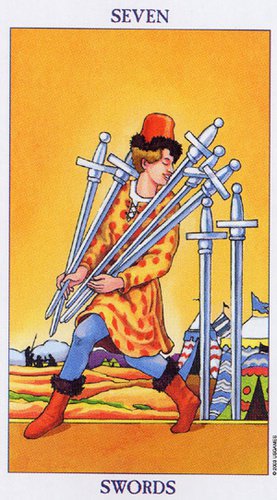
Seven of Swords


This card often conjures feelings of being robbed or cheated out of something. However , today I’d like to focus more on the intent of the character in the card who seems to be doing the cheating or robbing.

Loki, from the Norse tradition, is the god of thieves and mischief. In one myth he tricked Hod who was blind, into killing his beloved brother Balder, son of Odin, with a dart made of mistletoe – the only plant which had not sworn to never harm Balder. The imagery on this card is reminiscent of the wiles of Loki, and particularly prevalent on the face of the main character as he sneaks away in mischief.

In the seven of Swords card, we see a figure tip-toeing away; silently carrying away swords that clearly do not belong to him. It is apparent from further examination of this card that the scene is one of a jousting tournament. Tournament tents colourfully displaying their competing flags stand in the background. In the distant background a circle of knights stand together discussing the tournament in preparation of the competition. The scene is set for knights to display their skill and strength in this most important tournament. As was customary, the knights would bring their squires to such events. Medieval squires were the servants of the knights, in their training to become knights themselves. It was a very noble profession to be a knight, and a privilege to be a medieval squire, as that meant, more often than not, a potentially promising future if trained and knighted.

Back in the card, one can almost hear the squires of the various knights, hard at work in service of their masters to ensure that all the preparation are taken care of and that they have been thorough in their duties towards their knights.  The squires – like all squires of the time – are young and still need to prove themselves. They are in the service of their knights who will eventually train them to become  knights too. It would be self-defeating and self-destructive for these young squires to risk their entire future by being derelict in their duties towards their knights. Nothing could be more important to a young squire than  to ensure that all his master’s needs and expectations are taken care of, and that he has been diligent in his duties towards his benefactor.

Our attention is drawn back to the predominant figure in the card, that of the squire who is carrying away the very swords needed by the knights to perform their duty at the tournament. Judging by the expression on the face of the mischievous squire, he is not concerned at all with the consequences of his trickery! He has a self-satisfied grin on his face that tells us he finds the situation rather funny. A practical joker, that’s what this squire seems to be. Loki in all his mischievous glory. Which is all good and well, but how will the knights react when they discover that their swords have been misplaced, hidden or stolen from them? How will this impact on the tournament itself, that is kept waiting, while the tools of the trade are missing? Can you imagine the fury of the knights as they suffer humiliation at being disarmed? The fear of punishment and loss of future opportunities that potentially face the other young squires as their masters and knights look to them when it is discovered that their swords have been stolen, is almost tangible. Yet, it seems our irresponsible squire has not considered the impact of his practical joke on those around him, or himself. It seems that not a moment’s thought was given to the despair and confusion that this situation would cause for the knights, their squires and the tournament hosts. The severity of the situation is entirely lost on this squire.

This card reminds us that we should be mindful of how our actions may aversely affect others, even if our intent was not to harm. It cautions us to take responsibility for our actions, and to recognize when we have inadvertently hurt others simply because we weren’t paying attention, or because we didn’t consider the potential consequences of our actions.

When we do things that cause others pain, we cause ourselves pain.  When we do things that cause us to work against our own hopes and dreams we are self-sabotaging. Consideration of others happiness and welfare is paramount in our quest for self-development, but, as with so much else it all begins with the relationship we have with ourselves.